


Home /News /Industry News /Samsung's 2nm Mass Production Nears: A Crucial Bid to Turn Around Its Foundry Business /
Samsung's 2nm Mass Production Nears: A Crucial Bid to Turn Around Its Foundry Business
author: Hover Technology
2026-02-04
Samsung Electronics is gearing up to begin mass production of its 2nm fabrication process in the second half of 2026, marking a pivotal move aimed at reversing significant losses in its contract chipmaking division. According to securities firm estimates, the foundry unit is projected to post an operating loss of approximately 6 trillion won (about $4.3 billion USD) in 2025. The company expects this deficit to be halved to around 3 trillion won following the full-scale rollout of the 2nm node.
During its Q4 2025 earnings call, Samsung confirmed that the development of its second-generation 2nm process is on track, having met yield and performance targets, with mass production slated for late 2026. The company is actively collaborating with key customers on PPA (Power, Performance, Area) evaluation and test chips.
The production will be centered at the company's new $37 billion advanced fab in Taylor, Texas, which is set to come online in 2026. A major breakthrough came in July 2025 when the Taylor facility secured orders for Tesla's next-generation AI6 autonomous driving chips, signaling a potential business recovery. Furthermore, a $16.5 billion semiconductor supply deal with Tesla in 2025 is expected to enhance the credibility of Samsung's 2nm technology.
A Daunting Competitive Landscape
However, Samsung faces intense competition. Industry leader TSMC commands about 70% of the global foundry market and reports superior 2nm yields of 70-90%, compared to Samsung's estimated 50%. TSMC's aggressive capital expenditure plan of $52-56 billion for 2025 underscores its commitment to maintaining lead. Additionally, U.S. government support for Intel, including roughly $8.9 billion in investment, coupled with a potential $5 billion backing from NVIDIA for future GPU production on Intel's 1.4nm node, adds another layer of competition.
Differentiation and Future Roadmap
To compete, Samsung is leveraging its "total solution" strategy, offering a one-stop service encompassing design, foundry, memory, and advanced packaging. Kang Seok-chae, VP of the Foundry Business, noted that the number of 2nm projects for HPC and AI applications is set to grow over 130% in 2025. Looking ahead, Samsung is developing a 1.4nm process targeting mass production in 2029, with a PDK 1.0 version planned for customer distribution in the second half of 2027. As next-generation business director Kim Hyung-jun highlighted, there is U.S. expectation for Samsung to fill production gaps unmet by TSMC, making the demonstration of its advanced technical capability more urgent than ever.
Disclaimer: This article synthesizes information from financial reports, company announcements, and industry analysis. Financial projections, yield estimates, and technology roadmaps are subject to change based on market conditions, execution, and competitive dynamics. This content is for informational purposes only and does not constitute investment advice or a guarantee of future performance.
National Supercomputing Internet Launches Core Node, Offering 30,000+ Domestic AI Chips in Trial Run
2026 Trends to Watch: Telco Cloud & Network Automation
Related Article
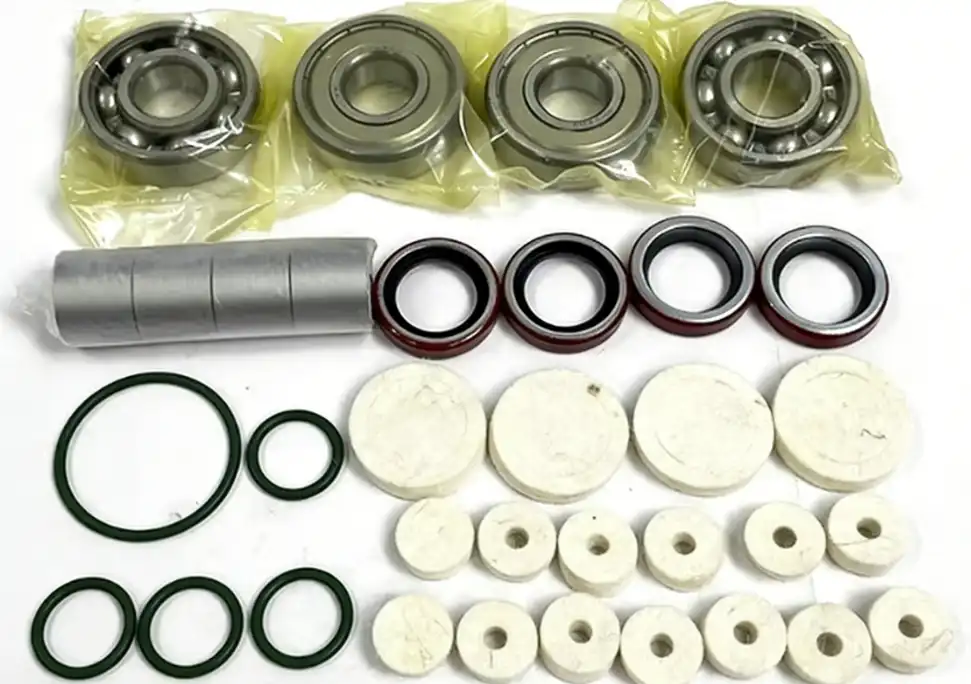
The Edwards A30151820 Module Kit is a comprehensive maintenance replacement solution designed for Edwards EH250, EH500A, QMB250, and QMB500A mechanical booster vacuum pumps. Engineered to restore factory tolerances and prevent vacuum leaks, this all-in-one overhaul kit includes high-precision ball bearings, durable dynamic shaft seals, heat-resistant O-rings, and oil-absorption felt pads for extended operating life.
Keep Your EH/QMB250/500A Pumps Running: Edwards A30151820 Module Kit in Stock

Agri-Core No.1, China’s first homegrown LoongArch agricultural SoC, has taped out. This industrial-grade chip resists heat, corrosion, and vibration, solving import reliance and interface mismatches for reliable farm machinery operation in harsh fields.
China's First LoongArch-Based Agricultural SoC -Agri-Core No.1- Successfully Tape-Outs, Breaking Import Dependence for Smart Farming Chips