

The Silent Failure Inside Your Edwards XDS35i: A Worn Gas Ballast Valve and the $100 Kit That Fixes It FOR IMMEDIATE RELEASE
The Silent Failure Inside Your Edwards XDS35i: A Worn Gas Ballast Valve and the $100 Kit That Fixes It

1. It Doesn't Fail Loudly. It Fails Slowly
Here is a scenario every vacuum maintenance engineer knows too well. It is 1 a.m., the freeze dryer alarms, and the chamber will not reach set vacuum. The operator checks everything: the inlet filter is clean, the motor current is normal, and there is no strange noise. The pump seems perfect. But pump-down time is 15 minutes longer than it was last week.
Nobody suspects the gas ballast valve. It is small, it is cheap, and it is quietly robbing your XDS35i of performance, long before any alarm goes off.
2. Why the XDS35i Is So Reliable You Forget It Needs Maintenance
The Edwards XDS35i is a dry scroll pump: two interleaved spiral scrolls, one fixed and one orbiting, sweep progressively smaller crescent-shaped chambers to compress gas from the outer inlet to the centre exhaust, with zero oil and zero contact between the moving surfaces. Tip seals compensate for the radial clearance. The result is a clean, hydrocarbon-free vacuum that made this pump the default choice in laboratories, analytical instruments, freeze dryers and light-industrial coating.
What this architecture hides is a real limitation: a dry scroll pump has no oil film to wash condensate out of the compression chamber. Once vapour condenses inside a scroll pump, it stays there.
Key parameters of the XDS35i
- Peak pumping speed: 35 m³/h (21 CFM)
- Ultimate vacuum (without gas ballast): 0.01 mbar
- Ultimate vacuum (with gas ballast): 0.02 mbar
- Maximum water vapour inlet pressure: 35 mbar
- Water vapour handling capacity: 240 g/h with gas ballast on
- Maximum continuous inlet pressure: 40 mbar
- Maximum gas ballast inlet pressure: 0.5 barg
- Sound pressure: 57 dB(A)
That 240 g/h water vapour figure only exists because of one component: the gas ballast valve.

3. What the Gas Ballast Valve Actually Does
Gas ballast is physics, not magic. It comes down to saturated vapour pressure and partial pressure.
When the pump compresses a mixture that contains water or solvent vapour, the vapour's partial pressure rises. If it reaches its saturation point before the exhaust valve opens, the vapour condenses into liquid inside the scroll chamber, exactly what you do not want in a dry pump.
The gas ballast valve fixes this by admitting a controlled flow of dry air or nitrogen into the low-vacuum stage during compression. This raises the partial pressure of the non-condensable fraction, keeping the vapour above its saturation point. When the exhaust valve opens, typically around 1.05 to 1.2 bar absolute, the vapour exits as gas, mixed with the ballast air, without ever liquefying.
Two things most operators get wrong about it
- Opening gas ballast makes the vacuum worse. Yes, deliberately. With ballast on, the ultimate vacuum drops from 0.01 mbar to 0.02 mbar. That is not a fault; it is the designed trade-off: you sacrifice a little ultimate vacuum to gain vapour-handling capacity. Running ballast on a dry process just to be safe is a needless hit; running a vapour process without it is how pumps die.
- Ballast works better on a warm pump. Ballasting raises operating temperature, and higher pump temperature further boosts vapour handling. Industry practice: run the pump with ballast open for about 20 to 30 minutes to bring it up to temperature before pulling condensable vapour, and after a vapour run leave ballast open for 30 to 60 minutes to flush residual moisture out of the scroll chamber. This is the same recovery technique Edwards recommends for scroll pumps: a ballasted run clears the chamber and restores ultimate vacuum far faster than blanking the inlet.
4. What Is in the Kit, and Getting the Variant Right

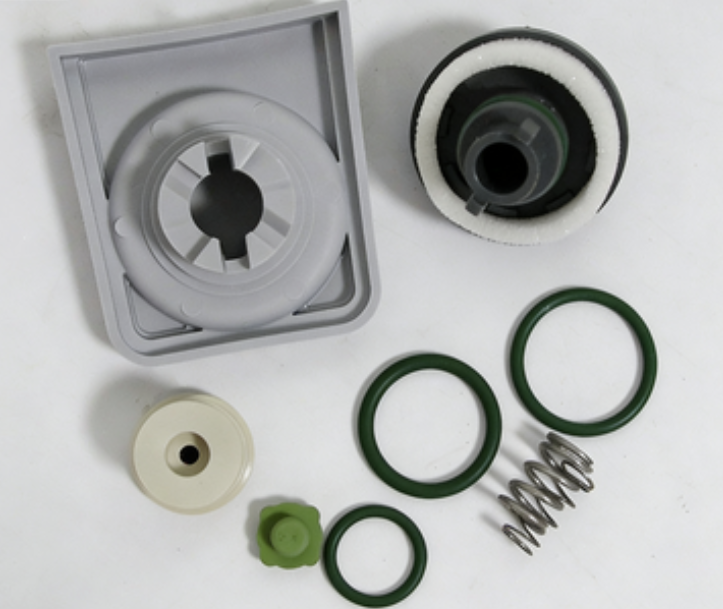
The A73001803 gas ballast service kit is the official Edwards replacement set for the XDS35i gas ballast valve. It contains the valve pad, non-return spring, two FKM O-rings and the gas ballast insert, everything needed for a complete valve exchange in one order instead of sourcing loose parts across multiple lines.
One selection red line: if your pump is a chemical-resistant variant, XDS35iC or XDS35iCE, you need the A73001815 Chemraz kit. Chemraz fluororubber holds up where standard FKM degrades under aggressive media. Fitting the standard FKM kit on a C-variant pump is a compatibility error that will come back to bite you. Check the pump nameplate and serial number before ordering, and if you are unsure, get a cross-reference confirmation before you buy.
EDWARDS Vacuum Pump Handheld Remote Controller: Key Specs, Setup & Use Cases
Related Article