


Beyond the Hype: Only 12% of CEOs See Both Revenue and Cost Gains from AI, PwC Survey Finds
author: Hover Technology
2026-02-12

DAVOS – Five years into the generative AI revolution, the gap between ambition and execution has never been wider.
According to PwC's 29th Global CEO Survey, released during the World Economic Forum in Davos, more than half of business leaders have yet to see any financial return from their AI investments—while a small vanguard of 12% are reaping the "jackpot" of both higher revenue and lower costs .
The findings, based on responses from 4,454 CEOs across 95 countries and territories, paint a stark picture of an industry at a crossroads: AI is universally acknowledged as transformative, but most organizations remain stuck in pilot purgatory .
📊 The AI ROI Divide: Four Camps, One Winner
PwC's data reveals four distinct outcomes among AI-adopting enterprises:
|
Outcome Category
|
Share of CEOs
|
Description
|
|---|---|---|
|
Both Revenue ↑ & Cost ↓
|
12%
|
The "vanguard"—achieving measurable dual benefits
|
|
Revenue ↑ Only
|
~8%
|
Top-line growth without cost efficiency
|
|
Cost ↓ Only
|
~13%
|
Operational savings without revenue lift
|
|
No Financial Benefit
|
56%
|
No significant revenue or cost impact to date
|
|
Mixed/Other Outcomes
|
~11%
|
Cost increases, revenue declines, or offsetting effects
|
Source: PwC 29th Global CEO Survey (2026). Figures are compiled from multiple reports .
In total, one-third (33%) of CEOs reported gains in either cost or revenue, leaving the vast majority—56%—still searching for a return on their AI spending .
🏆 The 12%: Who Are the Winners?
The "vanguard" 12% share a distinct profile: they are applying AI extensively across products, services, and customer experiences, rather than confining it to isolated pilots or internal support functions .
PwC Global Chairman Mohamed Kande described 2026 as "a decisive year for AI," warning that the gap between leaders and laggards "will widen quickly for those that don't act" .
These high-performers are two to three times more likely than peers to embed AI into strategic decision-making, demand generation, and core product roadmaps .
🧪 The Pilot Trap: Why 56% See Zero Return
The single biggest barrier to AI value? Scale—or the lack of it.
PwC warns that "isolated, tactical AI projects often don't deliver measurable value" —a phenomenon the firm terms "innovation theater" : activities that resemble innovation but produce no tangible business outcome .
Less than one in ten CEOs (8%) reported that their organization had adopted at least five of six key "innovation-friendly practices" to a large extent .
Key execution gaps include:
-
Only 51% have a clearly defined AI roadmap
-
Just 45% say their AI investment is sufficient to meet goals (global average; UK CEOs: 33%)
-
Nearly half are still in early stages of building AI skills, infrastructure, and governance
-
Only 14% of employees use generative AI daily in their work—a 2025 PwC finding that underscores limited adoption
📉 CEO Confidence at Five-Year Low
The payoff gap is taking a toll on leadership sentiment.
Only 30% of CEOs are confident about their company's revenue growth over the next 12 months—down from 38% in 2025 and 56% in 2022 , marking a five-year low .
42% cite "the pace of technological change" as their single biggest concern, outweighing inflation, geopolitics, and even cyber risk .
💰 The $650 Billion Question
Even for the winners, the math remains daunting.
Morgan Stanley recently estimated that the AI industry must generate $650 billion in annual revenue to justify current investment levels and deliver a 10% return—equivalent to $34.72 per existing iPhone user or $180 per Netflix subscriber [user-provided context].
This places unprecedented pressure on enterprise AI leaders to move from pilots to P&L impact.
🔭 From Tactical to Strategic: Bridging the Chasm
PwC's prescription is clear: more AI, not less—but applied differently.
"Companies that invest in data readiness, a clear AI roadmap, responsible guardrails, and a culture that enables adoption are getting better outcomes," said Kande .
The report urges CEOs to shift focus from short-term efficiency plays (47% of their time currently goes to issues with <1 year horizons) toward enterprise-wide deployment aligned with long-term strategy .
Claire Reid, Head of Risk at PwC UK, framed the choice facing business leaders: "There is risk to moving too fast, but increasingly there is a risk to moving too slowly."
🔮 2026: The Year of Scaling—or Stalling?
With just 9% of CEOs reporting that AI scaling efforts have reached a value-delivering stage, and only 12% offering AI-powered products to customers at scale, the majority of enterprises remain in "early stage" or "planning" mode .
The coming 12 months will determine whether 2026 enters business history as the year AI finally delivered—or the year the hype caught up with reality.
*This article is based on publicly available information from PwC's 29th Global CEO Survey (2026) and related media coverage, as cited throughout the text. All statistics, quotes, and findings attributed to PwC are the intellectual property of PricewaterhouseCoopers and its affiliates. This content is provided for informational and editorial purposes only and does not constitute professional investment, business, or technology advice. The publisher makes no representation or warranty regarding the accuracy, completeness, or timeliness of the information contained herein. Third-party estimates, including Morgan Stanley's revenue projection, are referenced from user-provided context and have not been independently verified. Readers should consult qualified professionals before making business or investment decisions. The views expressed in this article do not necessarily reflect those of the publisher or its affiliates.*
GlobalFoundries Surges 16% on Strong Q4 Results, Upbeat Guidance, and $500M Buyback
How Deep Tech Survives: The Boston Dynamics Story and What It Teaches Us
Related Article
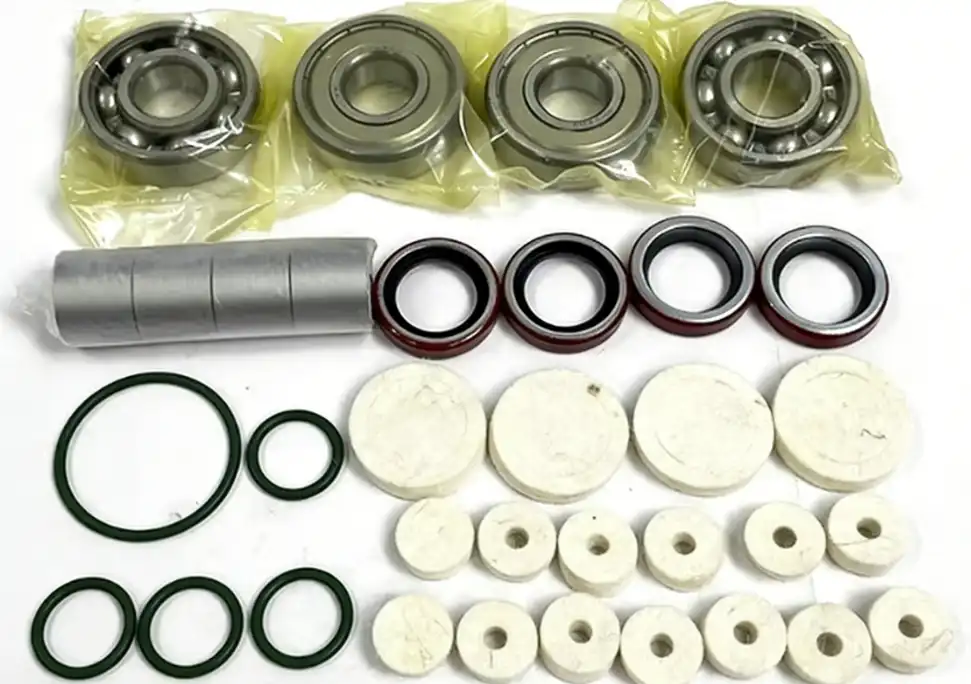
The Edwards A30151820 Module Kit is a comprehensive maintenance replacement solution designed for Edwards EH250, EH500A, QMB250, and QMB500A mechanical booster vacuum pumps. Engineered to restore factory tolerances and prevent vacuum leaks, this all-in-one overhaul kit includes high-precision ball bearings, durable dynamic shaft seals, heat-resistant O-rings, and oil-absorption felt pads for extended operating life.
Keep Your EH/QMB250/500A Pumps Running: Edwards A30151820 Module Kit in Stock

Agri-Core No.1, China’s first homegrown LoongArch agricultural SoC, has taped out. This industrial-grade chip resists heat, corrosion, and vibration, solving import reliance and interface mismatches for reliable farm machinery operation in harsh fields.
China's First LoongArch-Based Agricultural SoC -Agri-Core No.1- Successfully Tape-Outs, Breaking Import Dependence for Smart Farming Chips